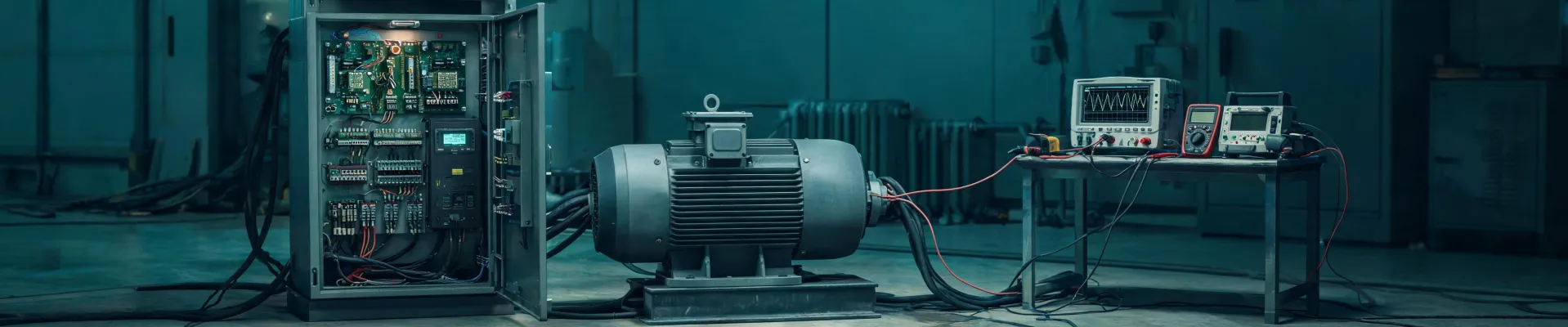
Most Allen-Bradley PLC Emergencies I Get Called For Aren't Hardware Failures
I've been doing field service in industrial automation for eight years. In that time, I've handled more than 200 emergency PLC service calls—same-day turnarounds, middle-of-the-night phone support, the whole thing.
So here's an opinion that doesn't always make me popular with clients: most of the "emergencies" I get called for aren't hardware failures. They're knowledge gaps.
That might sound like I'm blaming the customer. I'm not. I'm pointing at an industry-wide blind spot. People buy Allen-Bradley PLC controls because they're reliable. Then they treat them like sealed black boxes—call someone when it breaks, don't ask questions otherwise. In my experience, that approach costs more than any hardware premium.
Let me show you what I mean with the three patterns I see over and over on Allen-Bradley PLC controls.
The battery nobody checks (and the two-minute multimeter trick)
Everything I'd read about PLC reliability early in my career said the same thing: the hardware is bulletproof, focus on the program logic. In practice, the single most preventable failure I see is a dead backup battery.
Most plant managers focus on the Allen-Bradley PLC card itself and completely miss the battery that keeps the program alive during a power loss. When that battery dies, the processor can lose its program. If there's no backup, you're rebuilding logic from scratch while the line sits idle.
Here's the part that surprises people: these backup batteries aren't rechargeable. You can't top one off with a dirt bike battery charger or any generic charger—the chemistry and voltage profile are completely different. (And yes, I've been asked. Twice.) When it's low, you replace it. That's the deal.
How to test an PLC backup battery with a multimeter
This is a two-minute job, and it's the closest thing to a no-brainer in preventive maintenance:
- Power down the rack following your site's lockout procedure.
- Locate the battery on the processor or the battery module. The exact spot depends on the platform—CompactLogix and ControlLogix differ here.
- Set your multimeter to DC voltage. Measure across the battery terminals.
- A healthy lithium backup battery should read around 3.6V. Below 3.0V, replace it. Don't wait for the low-battery LED—by then you're already on borrowed time.
Roughly speaking, replacement batteries run $30–80 depending on the model. Take that with a grain of salt—pricing shifts, and distributors vary. But compare it to the cost of a lost program and a stalled line. It's not close.
I still kick myself for a call back in 2022. A packaging client had a CompactLogix fault during a weekend changeover. The battery was dead, the program was gone, and their last backup was eight months old. We got them running by Monday afternoon. The overtime and lost output landed somewhere in the $12,000–15,000 ballpark—for a part that costs less than dinner for two.
After that, we added a battery check to every preventive maintenance visit. It's not glamorous. It just works.
Most "bad" Allen-Bradley PLC cards aren't bad
The question everyone asks when a card faults is "which one do I replace?" The question they should ask is "what is this card actually seeing?"
I've stopped counting how many times a client has ordered a replacement Allen-Bradley PLC card before I arrived, only to find the original was fine. Bad grounding. A power supply drifting out of spec. A field device shorting intermittently. The card was reporting a real problem—just not its own.
This is where a multimeter earns its keep again. Before you swap hardware, check voltage at the card, check your commons, check for ground loops. In my experience, maybe one in four "failed" cards I'm called out for is actually failed. The rest are symptoms.
The way I see it, a replacement card is a $500–2,000 bet on a guess. A few minutes with a meter is a diagnosis. One of those is a lot cheaper than the other.
If only one or two people can touch your PLC, that's a red flag
I've walked into plants where the entire operation depends on one Allen Bradley PLC programmer who knows the system. That person takes a vacation, and everyone holds their breath.
I get why it happens. Programming software is intimidating. Ladder logic looks like a foreign language if you've never been trained. So companies concentrate the knowledge in one or two people and call it efficiency.
But it's not efficiency. It's a single point of failure that no redundant CPU can fix.
You don't need everyone to write logic. But someone on every shift should know how to pull a program, check a battery, read a fault code, and verify a card's inputs. That's the difference between a two-hour fix and a two-day shutdown.
Some managers push back on training. "What if they leave and take the knowledge?" Fair question. But the alternative—one person holds all the operational knowledge—is worse. An informed team asks better questions and makes faster decisions. That's not a slogan. It's what I see on site.
"Training takes time we don't have"
Sure, I get it. Production schedules are tight. Pulling people off the floor for training feels like a cost with no immediate return.
But let's do the math. A one-day basic troubleshooting course—multimeter use, battery checks, fault code reading—might cost a few hundred dollars per person. A single unplanned stop on a mid-size line can burn through that in an hour. The bottom line: you're already paying for the knowledge gap. The only question is whether you pay for it upfront or at 2 a.m. on a Sunday.
I'd rather spend ten minutes showing a maintenance tech how to test a battery than get a panic call six months later. An informed customer doesn't just make my job easier—they make fewer emergency calls in the first place. That's good for everyone.
So where does that leave you?
Look, I'm not saying hardware never fails. It does. But in eight years of emergency calls, the pattern is hard to ignore: the plants that treat Allen-Bradley PLC controls as something to understand, not just something to buy, spend a lot less time in crisis mode.
Start with the battery and the multimeter. Then get someone else trained on the basics. It's a small investment that prevents very large problems—and it beats the alternative of learning this stuff at 2 a.m. with a line down.
Your Allen-Bradley PLC is probably more reliable than your team's understanding of it. Close that gap.

Marta Kowalska
Marta Kowalska is an electrical equipment procurement and quality analyst covering distribution gear, automation, generators, pumps, test instruments, and engineered assemblies. She reviews IEC 61439 routine-verification records for assembly current and temperature rise, IEC 60034-1 rating and test data for rotating machines, and ISO/IEC 17025 laboratory scopes for reported calibration uncertainty. She helps buyers compare inspection status, document traceability, total installed cost, lead time, service access, spare-parts support, warranty boundaries, and failure consequences across equipment categories.