Drive application desk · Mon–Fri 8:00–17:00Global project support
Application matrix

Start with the process load, not a catalog thumbnail

Fans, pumps, conveyors, compressors, and machine axes place different demands on overload capacity, braking, speed control, harmonics, enclosure design, and automation.

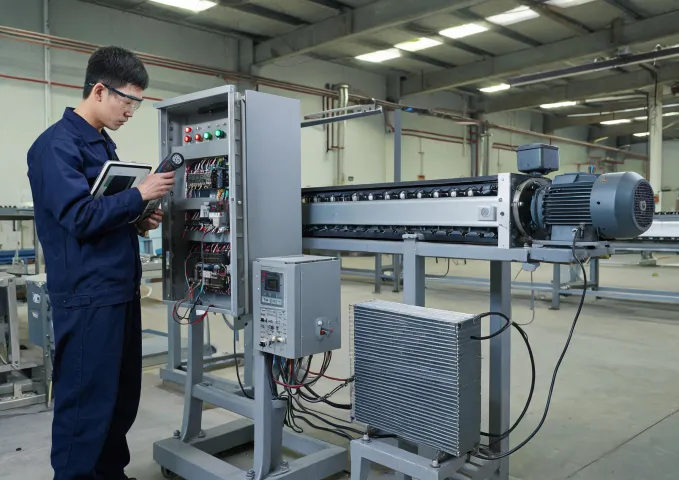
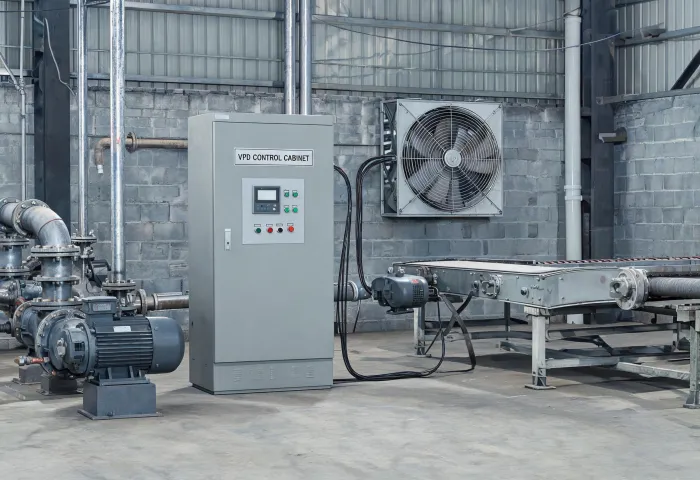
VFD-controlled pump and production line applications

Compare by load behavior and operating consequence

Pumping and water treatment

Variable-torque pumps often reward pressure or flow control, yet the design must still cover minimum speed, cooling, dry-run behavior, resonance, sleep logic, and restart philosophy. Outdoor or wet areas make ingress protection and condensation controls material. Long motor cables can affect dv/dt filtering and insulation stress. Harmonic mitigation belongs at the system level, based on loading and utility requirements.

Air handling and building services

Fan systems require a clear relationship between sensor control, fire-mode behavior, bypass philosophy, acoustic limits, and building-management communication. A bypass can improve service continuity but adds components and coordination work. Ratings must be checked at the actual ambient temperature and switching frequency rather than copied from a nominal table.

OEM machinery and material movement

Conveyors and constant-torque loads can demand stronger overload capacity than centrifugal equipment. Rapid cycles, braking energy, encoder feedback, safe torque off, fieldbus timing, and machine interlocks affect architecture. Parameter sets need version control when machines are replicated; firmware or option differences can invalidate an assumed copy-and-run procedure.
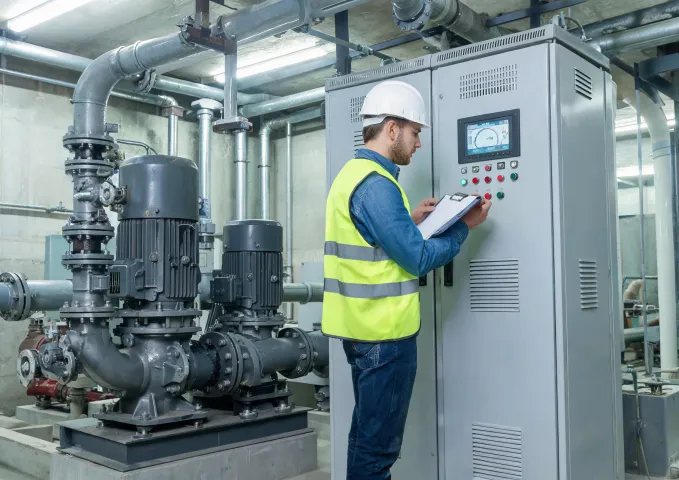
Pump station VFD panel review
Scenario worksheet

Pressure-control retrofit

Background: an existing fixed-speed pump installation is being reviewed for variable-pressure operation. Process: record motor current, pump curve, minimum flow, sensor signal, enclosure environment, cable distance, and protection scheme; then model operating points and define control ownership. Result: the project team receives a testable sequence and a configuration brief, not a promised energy figure. Savings require site measurements and duty-cycle evidence.

Conveyor drive control commissioning
Scenario worksheet

Conveyor replacement during a planned stop

Background: an obsolete drive must be replaced without assuming terminal or parameter equivalence. Process: capture model code, motor plate, I/O schedule, braking hardware, network node, safety chain, footprint, and saved parameters; map each function to the proposed device. Result: wiring changes, commissioning checks, rollback steps, and required spares are visible before the shutdown window.

Centralized versus distributed control

Centralized coordination

A central PLC can simplify common sequencing, data ownership, and change control. It also concentrates integration work and may enlarge the effect of a controller or network interruption.

Distributed drive intelligence

Local control can isolate functions and sustain selected machine behavior, but parameter governance, diagnostics, and lifecycle maintenance become more distributed. The right boundary depends on failure response and support capability.

Limits to disclose: current capability may derate with ambient temperature, altitude, enclosure heat, or switching frequency; motor insulation and cable length can require output filtering; efficiency gains depend on actual load profile and cannot be inferred from installing a VFD alone.

Define the load

Provide the process, motor data, speed range, duty cycle, and environmental conditions.

Talk to an Engineer

Define the supply path

Include voltage, fault-current context, upstream protection, harmonics, and network requirements.

Review Product Categories