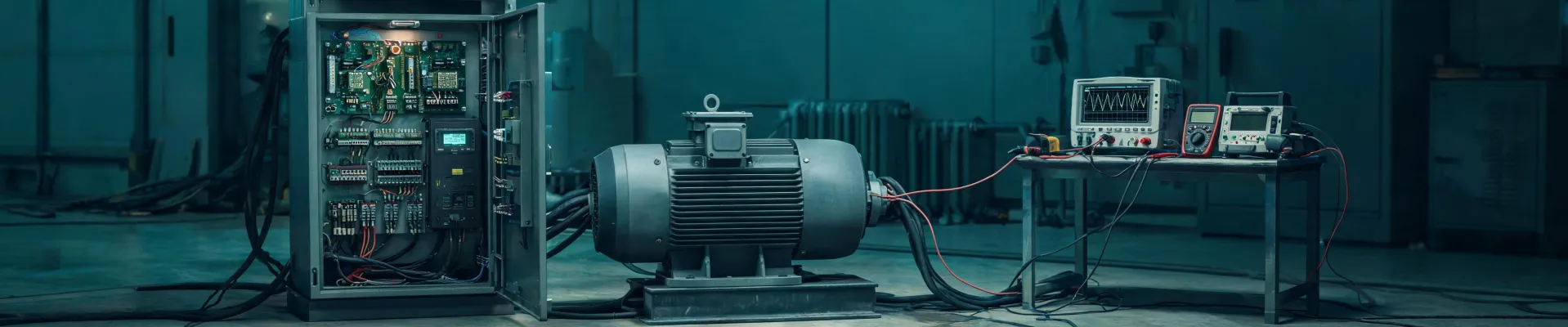
There's a specific kind of quiet that happens in a plant when the panels are built, the wiring is landed, and two of nine drives just... don't talk to the controller. Not slow. Not flaky. Nothing. I know that quiet pretty well, because I caused it.
The job that cost me $4,200 and eleven days
September 2022. A packaging line retrofit — three control panels, nine conveyors, one very patient plant manager. I had a purchase order in front of me, a stack of datasheets I'd skimmed rather than read, and a deadline that made skimming feel reasonable.
We powered up on a Tuesday. Two drives stayed dark. Eleven days and roughly $4,200 later — expedited replacement modules, two electricians on standby, a production window we had to rebook with the customer — we found the cause: I'd ordered I/O expansion units based on what the catalog photo looked like, not on what the compatibility table said.
The distributor hadn't sent the wrong part. I'd ordered the wrong part. With total confidence. That's the part that stings.
What I told myself the problem was
For about two years I kept a running list of explanations. Supplier lead times. A packaging error somewhere in the chain. A spec sheet that 'wasn't clear.' Bad luck on a Monday.
None of those were exactly wrong. They were just downstream. The actual cause was sitting upstream the whole time, in the ten minutes before I clicked 'submit order.'
In Q1 2024, after the third rejected submittal on a different project, I finally sat down and pulled every rework ticket from the previous three years. Seventeen of them. I sorted by root cause the way you'd sort receipts at the end of a quarter.
Eleven had the same shape: I assumed two things were interchangeable because they looked interchangeable.
Not a supplier problem. A me problem — specifically a 'I verified this with a photo instead of a table' problem.
The deeper issue: 'looks the same' is a category error
Once I saw the pattern, I couldn't unsee it. It wasn't a PLC thing. It was a habit, and it had spread into every corner of how I bought parts.
Circuit breakers don't photograph their specs
I used to pull up circuit breaker types pictures to sanity-check a selection. MCB, MCCB, ACB, RCD — the outlines are distinct enough that you feel like you're actually verifying something.
But a photo won't tell you the interrupting rating. It won't tell you the trip curve, the pole count, the breaking capacity in kA, or whether the device carries the certification your inspector is going to ask about. Two breakers that look identical in a web image can differ by an order of magnitude in short-circuit withstand.
Per IEC 60947-2, the standard covering low-voltage switchgear and circuit breakers, those ratings are the entire point of the device. The housing is just what holds them. I was evaluating the housing.
(Note to self: never again select a protective device from a thumbnail. Verify current standard scope at iec.ch before you spec.)
Remote controlled circuit breakers aren't 'a breaker with an app'
This one bit me on a building automation job. I quoted what I assumed was a straightforward upgrade: swap in remote controlled circuit breakers so the facility team could reset trips from the BMS instead of walking out to the panel at 2 a.m.
What I missed is that 'remote controlled' isn't one thing. Some units need a separate control voltage. Some speak a specific protocol and won't talk to anything else on the bus. Some have a defined fail-safe state on loss of control power. And some don't — which is the category that gets you stuck in a fire alarm interlock review for six weeks.
None of that is visible in a product photo. All of it is visible in the wiring diagram, which I hadn't opened.
The Omron CP1E lesson
The CP1E is a genuinely good compact controller. It's also where I learned that 'same family' does not mean 'same architecture.'
On a small retrofit, I assumed the expansion I/O I'd used on other Omron PLC series would carry over to an omron plc cp1e build. It didn't, at least not the way I'd assumed. The expansion options and the addressing behave differently enough that the program I'd already sketched needed rework before it would compile cleanly.
The information was all there. Omron publishes compatibility and expansion tables on omron.com. I'd simply never opened them, because I'd 'confirmed' the details with a photo and a two-year-old memory.
If you're doing plc training omron courses — and I eventually took one — this is the habit worth building on day one: read the compatibility table before you read the price. The training would have paid for itself on that single job, which is a slightly embarrassing thing to admit about a course I'd put off for a year.
What this actually costs you
People underestimate the damage because the invoice is the visible part. The invisible part is worse.
- The expedite fee shows up on the invoice. The two electricians standing around for a day and a half shows up on the invoice. The plant manager explaining the delay to his production director does not.
- One wrong module can invalidate a panel submittal. That's a re-review cycle — sometimes a month, sometimes a quarter.
- After the third incident, your PM starts double-checking your specs. That's a tax on every order you'll touch for the next year, and it's a fair one.
We've caught 47 potential mismatches with the checklist below over roughly 18 months. Most would have been minor. Two or three would have been the September 2022 thing again. In my opinion, catching even one of those per year justifies ten minutes per order.
The routine that replaced all of it
Short version, because the analysis is the point and the fix is boring.
- Open the compatibility table, not the catalog. Manufacturer site, not distributor site, not the photo, not a two-year-old memory.
- Write the spec in a sentence before you write the PO. If you can't describe the part without pointing at a picture, you don't know what you're buying.
- Check the certification column. UL 489, UL 1077, and IEC 60947-2 are not interchangeable, and your AHJ cares which one you selected. Verify current listings at ul.com and iec.ch.
- Ask one dumb question per line item. 'Does this physically fit the thing it's replacing, including the control wiring?' If the answer is 'probably,' it's a no.
That's it. Ten minutes per order, and I haven't had a repeat of the 2022 failure since.
The same pattern on the maintenance side
If you've ever searched how to get an oil filter off a compressor and gotten eighteen contradictory answers, you already know where this is going.
I watched a tech try to get an oil filter off a screw compressor with a strap wrench, cold engine, no penetrating oil, and — this is the important bit — assuming a standard right-hand thread. Twenty minutes of increasingly creative language later, the filter can was oval and the gasket had torn. The whole housing had to come off.
More than a few oil filters on industrial compressors are reverse-threaded. The service manual says so, usually in the first three pages. Nobody reads page one before the wrench comes out.
Same error, different equipment. Assumed the thing was standard because most things are standard.
What I'm not qualified to tell you
I'm not an electrical inspector, so I can't sign off on a protective device selection for your installation. If your panel falls under a specific article of NFPA 70 — refrigeration and HVAC equipment has its own section, for instance — get your AHJ or a licensed engineer to review the selection before it goes into a submittal. My checklist catches my own mistakes. It does not replace a stamped drawing.
I can only speak to what I've personally gotten wrong on procurement and retrofit jobs at a mid-size manufacturer with fairly predictable ordering patterns. If you're running a much larger operation with a dedicated standards team, some of this is probably already formalized on your end, and the calculus might look different. If you're a small shop doing one retrofit a year, the frequency is lower but the per-incident hit is proportionally larger.
But the 'looks the same' habit doesn't care what size company you work for. It just waits for a busy Tuesday.

Omar Rahman
Omar Rahman is a power-conversion and quality analyst specializing in UPS systems, inverters, rectifiers, battery chargers, power supplies, and bypass arrangements. He applies IEC 62040-3 tests to UPS efficiency, output tolerance, harmonic distortion, overload behavior, transfer time, and autonomy, while using IEC 62477-1 to examine safety boundaries for other power-electronic converters. He helps facility and renewable-energy teams match conversion equipment to critical load profiles, runtime targets, redundancy, thermal conditions, maintenance strategy, fault behavior, and total ownership cost.