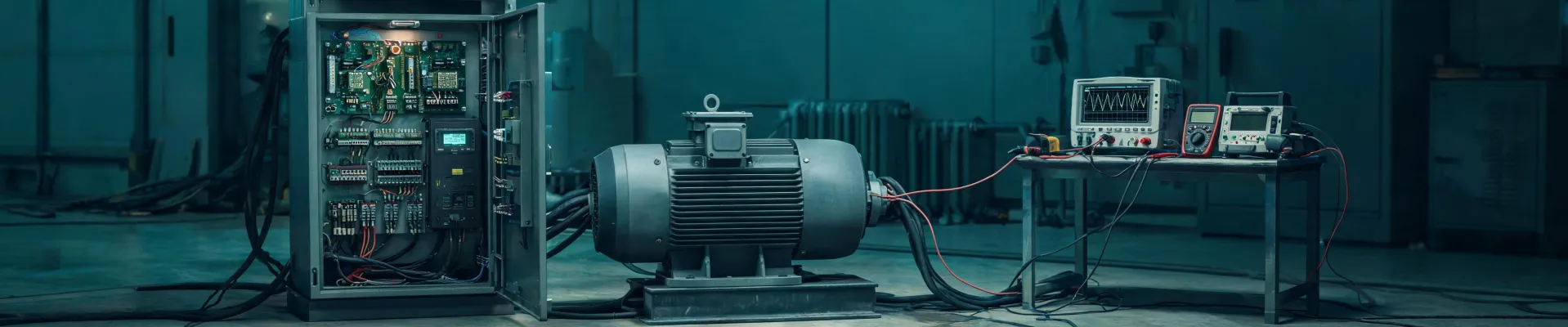
I took a call last March, a Friday, around 2 p.m. The customer had a 20 HP ABB drive running a pump off a rented 15 kW portable generator. The drive would start, run for about 90 seconds, then trip. They'd already spent $900 on the generator rental and were pricing a replacement drive.
The drive was fine. The generator sizing assumption wasn't.
I've handled dozens of these calls over the past several years — generator, drive, deadline, panic — and if there's one pattern that has held, it's this: the drive itself is the problem in maybe one out of seven cases. The other six are generator sizing, grounding, AVR response, or wiring. Most engineers under pressure get the order backwards.
The Surface Problem: You Think the Drive Is Broken
The symptom looks like a drive problem. The panel shows a fault. The motor stops. The line goes down. Human reflex says blame the device that's reporting the error.
If the drive is showing a DC bus undervoltage or an overcurrent trip, the easy conclusion is "the drive is bad." But look at it from a different angle. The same drive, running on utility power, has never tripped. It only trips when the generator is the source.
Once you map that timeline in your head, the problem shifts. It's not the drive that's failing. It's what the drive is being fed.
The Deeper Cause: Why a VFD Is Picky About Portable Generators
1. The generator is sized to the motor HP, not to the drive's demand
A 20 HP motor at 480V pulls roughly 27 amps at full load. That's about 15 kW of real power. So the assumption goes: "I'll put a 15 or 20 kW portable generator on it." Reasonable. Wrong.
Here's why: the VFD's input rectifier is not a linear load. It draws current in pulses, not a smooth sine wave. At the generator end, that nonlinear load distorts the voltage waveform, heats the winding, and confuses the automatic voltage regulator (AVR). The result is a supply that sags on every rectifier commutation. The drive reads a voltage dip and trips.
The industry rule of thumb is to size the generator at 1.5 to 2 times the motor HP — sometimes more, if you want reliable operation. For a 20 HP drive, that means a 30 to 40 kW generator, depending on the generator itself. If you're on a 20 kW unit, you're right at the edge. If you're on a 15 kW, you're under the floor.
2. AVR response is the real fork in the road, not "capacity"
This is the part most people miss. Two 40 kW portable generators can behave completely differently on a VFD load. One with a permanent-magnet exciter or auxiliary winding will respond in milliseconds. A standard capacitor-excited AVR takes 40 to 100 ms — which is too slow for a VFD's rectifier.
I've watched a customer rent a fully dressed generator at $8,000, then watch the same drive and load behave better on an older, smaller 30 kW unit with a PMG. Capacity is not the only metric. Voltage regulation speed is just as important.
3. Causation reversal: what you're calling a drive issue is actually the generator
Here's the argument that's hardest to accept. The assumption is that the drive trips because the drive is faulty, or set poorly, or just bad. The reality is the other way around. The drive is detecting — accurately — that the incoming power is too low to maintain the DC bus.
If the drive didn't trip, the problem would be worse. Voltage sag pulls the DC bus down, current spikes follow, and you can damage the motor or the rectifier. Tripping is a protective action, not a failure.
4. If you run a bypass, the contactor is right for something — just not this load
People sometimes ask whether a NEMA Size 4 contactor is right for a 20 HP drive. Answer: it will work, but it doesn't make engineering sense. A 20 HP, 480V motor pulls roughly 27A at full load. NEMA Size 1 is rated at 27A. NEMA Size 2 is rated at 45A. NEMA Size 4 is rated at 135A — around 50 HP.
You pay $300 to $500 more, take up more cabinet space, and get zero operating benefit. Granted, if you already own a Size 4, it will function — but for 20 HP, it's oversized. Not a safety margin. Waste. Size the bypass contactor to the motor's full-load current and starter class.
The Cost: One Trip Can Run into Thousands
If you treat a trip as a drive failure, the floor cost of being wrong looks like this:
- Rush replacement rental for a properly sized generator: $500–$800
- Wrong contactor or backup drive purchase: $200–$3,000
- Downtime — even four hours at production rates: $4,000–$12,000, easy
And if the outage runs through a weekend with a hard delivery, the bill doubles with penalty clauses.
But the procurement side gets uglier. A customer misdiagnosing the trip as a drive fault will often replace a 20 HP ABB drive based on the wrong premise. A reasonable price for a 20 HP ABB drive — depending on configuration, bare or with keypad and bypass — sits roughly in the $3,000–$6,500 range as of early 2025 (ballpark pricing, unverified). Plenty of customers get quoted above that because the configuration is wrong and over-specified.
The expensive one I actually saw: a customer replaced the drive three times over 14 months on the same generator set. Every replacement tripped on the first generator run — because the problem was never the drive.
The Fix: Short Version
Here's what I'd tell any customer before they decide to buy new hardware.
- Generator sizing: Size for 1.5–2 times the motor HP. For a 20 HP drive, you're looking at 30 kW minimum, with 40 kW comfortable if the unit has a PMG or auxiliary-winding AVR.
- AVR type: Ask for the generator's data sheet, not the nameplate kW. PMG or auxiliary winding is what you want.
- Support: ABB's regional technical support or an authorized distributor is the right first call for application questions — free engineering, and a much shorter path than a new drive. Call them before you buy anything.
- Bypass contactor: For a 20 HP motor, NEMA Size 2 is plenty. The number in the name doesn't make it better — it makes it more expensive. You almost certainly don't need Size 4.
- The drive itself: If the drive runs clean on utility power, don't rush to replace it. Check parameters first — specifically the DC bus undervoltage threshold and auto-restart settings — before you write a purchase order.
What I'm Not the Right Person For
Every now and then, someone asks us to bypass a fuel pump relay on the side, so the pump keeps running through the emergency. My answer hasn't changed: that's for a licensed electrician or plant technician. Fuel systems, relays, fire risk — that's an entirely different system with its own rules. The drive and generator work we do touches it, but the boundary is clear.
That's not a brush-off. It's what a real service partner should do — know what they're qualified to touch and what they're not. The vendor who says "we can fix anything" is usually flattering you to cover up something they don't do well.
If your drive is tripping, check the power source first. Odds are, the drive isn't the problem.

Kwame Boateng
Kwame Boateng is a transformer and power-conversion analyst specializing in distribution transformers, power supplies, inverters, and network integration. He uses IEC 60076 test data for transformer ratio, impedance, losses, and temperature rise, and IEC 62477-1 safety requirements for converter insulation and thermal boundaries while separately comparing harmonics and efficiency curves. He helps engineers and sourcing teams compare equipment against duty profiles, environmental limits, short-circuit behavior, lifecycle energy cost, and service requirements.