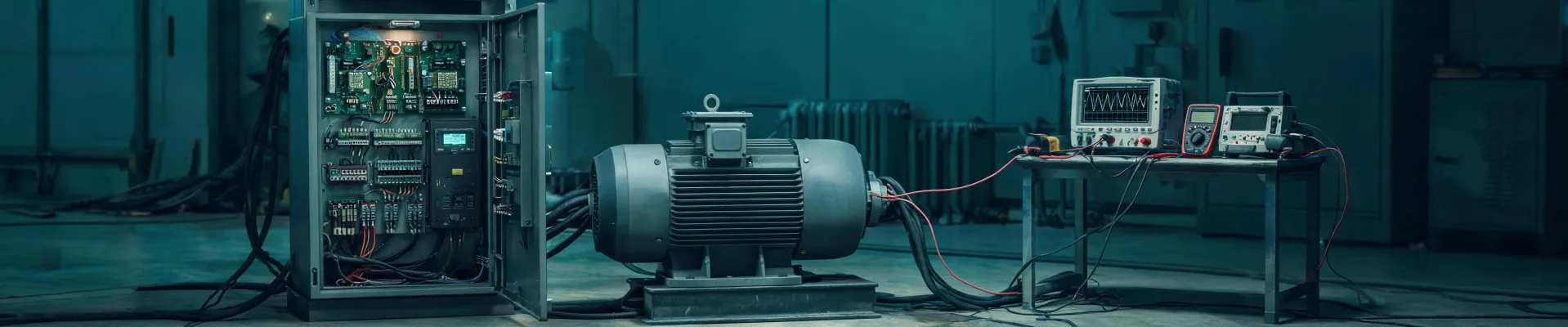
The email came in on a Tuesday. Operations needed a replacement Danfoss VFD for the packaging line before Friday. They also needed a timer for the cooling fan, a safety relay, and a copy of the safety PLC specifications for the updated press guard. My first thought was: I know exactly who to call. My second thought was: that's the problem.
I'm the office administrator for a 130-person manufacturing company. I manage the purchasing of electrical components—everything from contactors and relays to Danfoss VFDs. In dollar terms, that's roughly $400,000 a year across eight vendors. I report to both operations and finance, so I live in that space where price has to make sense but the production line can't stop.
When I took over purchasing in 2020, I thought the job was simple. Get three quotes. Pick the lowest. Move on. I remember telling a colleague, 'We're not buying anyone's intellectual property. We're buying a box with wiring terminals.' That was one of the stupider things I've said.
The Tuesday That Changed My Spreadsheet
The email was not dramatic. It was the kind of request I get at least twice a month: 'Need a replacement Danfoss VFD for the packaging line. Also need a timer, a safety relay, and the safety PLC specifications for the press work.'
I did what I always did. I looked up the part number from the old unit, sent it to a few suppliers, and asked for a price. The cheapest quote came from an online distributor I had never used. The price was about 12% lower than my usual source. The lead time was better too. So I placed the order.
The VFD arrived Thursday morning. That part was fine. The problem was everything else.
Dave, our maintenance lead, unboxed it and asked me for the wiring diagram. He needed to connect a stand-alone timer to the VFD's control input, and he also needed to verify the safety relay wiring against the existing safety PLC. I forwarded the summary I had received from the online vendor. It contained a terminal diagram and a warranty notice. No timer application notes. No safety relay wiring guidance. No safety PLC specifications.
I called the vendor. The first call ended with a voicemail prompt. The second call got me through to someone in billing. The third call connected me to a 'product expert' who told me to look at the manual. I already had the manual. The manual explained the VFD's features in general, not our specific setup.
Meanwhile, the line was still down. My operations manager was polite, but I could hear the cost of the downtime in his voice. I knew then that the online vendor's price was irrelevant. The invoice would be paid. The line would keep losing money. 'Cheap' had a hidden price, and it kept climbing.
The Part Was Not the Problem
After two hours of phone tag, I called a different supplier—one I had written off as too expensive. They didn't have the exact Danfoss VFD in stock for next-day shipping. But they did something more useful: they listened to Dave.
The person who answered asked what motor, what voltage, what the VFD was feeding, and whether we were using a safety PLC. I honestly didn't know all the answers. He didn't act annoyed. Instead he said, 'Put Dave on the phone.'
Dave spent twenty minutes with the distributor's application guy. That call produced a one-page wiring note, a list of recommended parameters, and a document that matched the safety PLC specifications for the new press guard. They also told Dave that the safety relay in the old panel did not meet the current relay compliance requirements for that application. The machine would not have been compliant if we had reused the original relay.
And here's the part that still gets me. When I compared the final invoices, the 'expensive' distributor was only about 3% higher than the online quote. Three percent. For that 3%, we gained a working installation, clean documentation, and a vendor who knew the difference between a safety PLC and a standard PLC. I had been optimizing the wrong number.
By Friday, the packaging line was running. Dave told me, 'That's the first time a supplier actually knew what they were shipping.' I've never forgotten that sentence.
What I Missed
From the outside, buying a Danfoss VFD looks like comparing part numbers and prices. The reality is that a part number is just a door. Behind that door is the support structure around it: the application notes, the parameter guidance, the safety integration advice, and the people who can explain relay compliance requirements without a dictionary.
Not all Danfoss VFD distributors are the same. Some can get you a part quickly. Some can get you a part quickly and also tell you why you need a specific input card for a timer, or which safety PLC specifications match your control system. Those two kinds of suppliers look identical on a spreadsheet until the moment they don't.
The 'any distributor with stock is fine' idea comes from an era when a VFD was a simple box with start and stop buttons. Today, a Danfoss VFD might be connected to a safety PLC, an external timer, and a network of relays. It might need to meet specific relay compliance requirements for a machine built in 2024. The assumption that every supplier carries that knowledge is a myth. Expensive myth.
It took me four years and about 200 orders to understand that the distributor relationship matters more than the distributor price sheet. I do not mean price is irrelevant. Price is relevant. But it is not the first question. The first question is: if something goes wrong, who will help me fix it?
What I Do Now
Today, my ordering checklist looks different. I still get quotes. I still compare lead times. But before I place an order for a Danfoss VFD, I ask a few extra questions:
- Does the person I'm talking to actually know the Danfoss VFD product line?
- Can they send application documentation with the quote?
- Do they understand what a safety PLC specification sheet includes?
- Will they take a call after the order is delivered?
I don't need a vendor to tell me what I want to hear. I need one to tell me what I need to know.
In our 2024 vendor consolidation project, I reduced my supplier list from eight to four. Some people thought I was creating a bottleneck. In fact, the four we kept had two things in common: they answered the phone, and they knew the difference between 'we have that in stock' and 'this will work for your application.' That distinction changed how I buy everything, not just VFDs.
The order that started this story is not unusual. It happens somewhere every week. But the lesson is reusable. When you buy a Danfoss VFD, you're not just buying a box. You're buying the experience that comes with it. The cheap quote feels great for the few days before the line stops. After the line stops, it feels terrible.
Simple.
And a lesson learned the hard way.

Rebecca Sloan
Rebecca Sloan is a power distribution and protection analyst specializing in circuit breakers, switchgear, contactors, fuses, surge protective devices, and coordination. She applies IEC 60947-2 breaker requirements, IEC 60269 fuse characteristics, and IEC 61643-11 tests while examining rated voltage, breaking capacity, time-current curves, selectivity, and prospective short-circuit current. She helps engineers and buyers compare protective devices against documented fault levels, installation conditions, maintenance access, and continuity priorities.