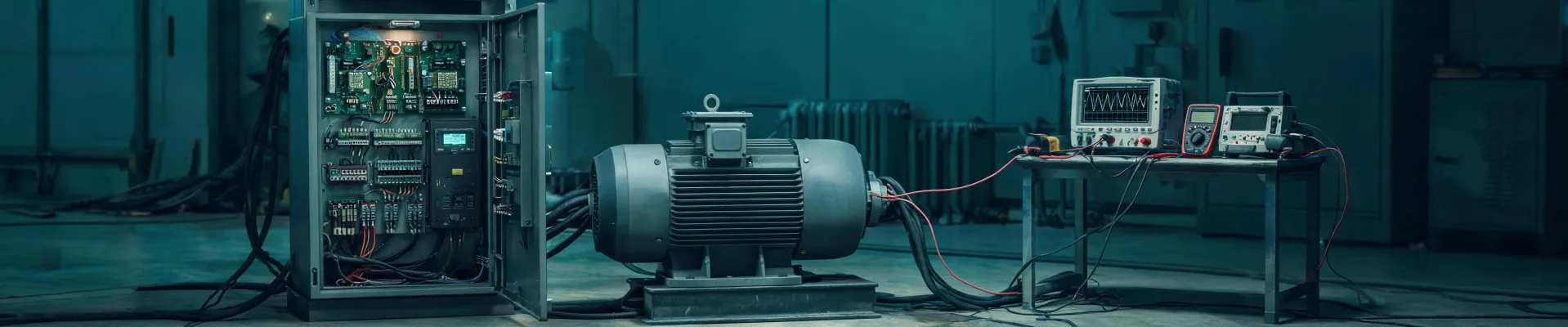
The call came in at 2:47 AM on a Tuesday in November 2025. A food processing plant outside Toledo, Ohio. Their main packing line had been down since just after midnight, and the voice on the other end had moved past panic into something that sounded dangerously close to resignation.
"The Danfoss VFD is dead. No display. No response. We need a replacement here by 7 AM or we miss the grocery chain deadline."
I've been doing industrial automation supply for nine years—Danfoss VFDs and the control components that live in the same panels. PLCs, contactors, relays, timers. I've processed more than 200 emergency orders in that time. Somewhere along the way, I learned that the word "dead"—when it's being used about a VFD at 3 AM—is wrong more often than people think.
From the outside, it looks like the fix for a dead drive is a new drive. The reality is that most of the VFDs I get called about aren't dead at all. They're just the most expensive component in the panel, so everyone assumes they're the first thing to fail.
"Dead" isn't a diagnostic
Before I pulled a part from the shelf, I asked the operator a question: what did the display show before it went blank?
"Flickered for a couple days. Like it was losing power. Then nothing."
Flickered. For days. Then nothing.
That answer didn't sit right with me. A drive that fails internally—a Danfoss VLT or any other—almost always logs a fault code first. Overvoltage. Heat sink temperature. Ground fault. Phase loss. It trips, and the display gives you a story about what happened. What it doesn't do is fade to black without a word, like a TV losing its signal.
That pattern says power supply. Either inside the drive or—more commonly—something feeding it.
The Danfoss VLT Operating Guide for the FC 102 lists fault codes and their meanings in detail. A blank display with no fault code is conspicuously absent from that list. Because when the control voltage to the drive drops out, the drive doesn't get a chance to tell you why. It just goes dark.
In the middle of the night, with a line down and a deadline approaching, that distinction is easy to ignore. And honestly, no one would've blamed us for shipping the drive.
We had the exact model on our shelf. A Danfoss VLT HVAC Drive FC 102, 25 HP, sitting in our Chicago warehouse. Overnight freight to Toledo would run about $350. The plant manager joined the call and gave me a sentence I've heard verbatim from probably fifty different managers: "Cost doesn't matter right now. Just fix it."
I understood. That packing line was producing roughly $6,000 of throughput an hour. A $6,800 drive was a rounding error compared to what they were losing every hour the line sat still. And when you compare drive wholesale costs—which is the kind of exercise we publish in our drive wholesale cost guide—the price of the part is usually the least interesting number in the equation. Downtime dwarfs everything.
But my gut wasn't cooperating.
The flickering display kept bothering me. So I asked for photos instead of packing a box. The control panel. The PLC rack. The power distribution section. The electrician on-site sent them over with visible reluctance, probably wondering why the supplier was playing detective instead of shipping the damn drive.
The 19.8-volt clue
The photos landed on my phone about four minutes later. And the first one changed everything.
There was the FC 102, dark as advertised, mounted in a clean panel with good wire management. There was the motor branch circuit, a soft starter, an older PLC that I recognized from about a hundred other plants. And there was a fault light blinking on the PLC's output module.
I asked the electrician to put his meter on the 24V DC rail feeding that PLC.
19.8 volts. Dropping below 19 under load.
There it was.
That PLC was starving. The 24V supply—a transformer-rectifier setup that looked like it had been in service since the Obama administration—was failing. At reduced voltage, the PLC's internal logic can stay alive but its outputs get unreliable. Outputs drop out intermittently. And when an output drops out, it can do strange things to the devices downstream.
That explained the flickering VFD display. The PLC's output to the drive's run command was making intermittent contact—not the drive, the PLC. And when the power supply sagged far enough, the output dropped for good, cutting both the run command and the holding contact that kept the circuit closed.
The drive went dark. The drive wasn't the problem. It was the victim of an upstream failure.
The real culprit was a $140 control transformer and a rectifier stack that was doing its best impersonation of a dead battery.
People think the drive failed because the line stopped. Actually, the line stopped because the control system starved. The causation runs upstream, not through the drive's power stage.
$275 instead of $6,800
We cancelled the VFD order. The plant manager went quiet for a moment and then said, with a hint of disbelief: "So we almost bought a $6,800 drive to fix a $140 transformer?"
Yes. That's exactly what would have happened.
Instead, we shipped the transformer, a new PLC that was a direct drop-in replacement, and a timer relay that had eleven years of service and was clearly on borrowed time. We're not just a Danfoss VFD supplier; we also operate as a PLC supplier and a timer supplier, and sometimes the components we sell alongside the drives are the ones that actually save the day.
The parts cost $275. The morning freight was $95. The electrician had the line running by 9:40 AM.
Just to make sure, we did a quick dry test on the drive before the replacement parts went in. The electrician jumped the run terminals on the FC 102—bypassing the PLC—and the drive spun the motor up to 60 Hz without a ripple. The drive's voice, if it had one, would have been: "I told you I wasn't broken."
The alternative path that morning didn't happen, but I know exactly how it would have played out.
The VFD would have arrived at 7 AM on the overnight truck. The contractor would have swapped the drive in by 9 AM. And when the new $6,800 drive came up with the same blank display—because the run command was still cut off by the dying PLC—the plant would have lost another full day chasing a ghost. The grocery chain deadline would have blown. The penalty clause was $50,000. And the relationship with the customer—the trust they'd placed in us, and in their own maintenance team's judgment—would have taken a hit that no invoice could repair.
Dodged a bullet on that one.
The industry moved on
I have mixed feelings about what happened next. The plant's maintenance contractor—a guy who'd been servicing their equipment for years—had insisted from the start that it was the VFD, and after the diagnosis, he still wanted to swap the drive. "Replace it and be done," he kept saying. "That PLC has run for ten years without a problem."
Look, I'm not saying the contractor was wrong in a lazy way. He was following a playbook that genuinely made sense in 2015. Back then, VFDs failed more often. Their capacitors aged faster, their thermal management was worse, and a drive that lost its display was frequently a drive that needed to be replaced. The logic was: big expensive component fails first, so replace the big expensive component.
That playbook has aged poorly.
The industry has changed. Modern Danfoss drives—the FC 102 included—are built to far tighter specifications. Better cooling. Better capacitors. Better protection circuitry. I've pulled drives from panels after a decade of heavy service and seen them meet their original electrical specs. Meanwhile, the ancillary parts—the control transformers, the 24V rectifiers, the timer relays, the old PLCs with their brittle capacitors—those are the components that are failing now. They sit in a warm panel for years, cycling daily, and nobody thinks about them because they're "not the expensive part."
The IEC 61800 series, which covers adjustable speed drives, treats the drive as part of a system—and that's exactly how you have to troubleshoot one. The drive is a component, not an island. What was best practice in 2020 does not hold up in 2025. The fundamentals haven't changed: you need the line running, and you need to know what's actually happening in the panel. But the execution has transformed. The smartest first move when a VFD goes dark isn't to quote a replacement drive. It's to check the system around it.
If you ever find yourself staring at a dark VFD display—with the pressure of a deadline, a penalty clause, or just an angry plant manager breathing down your neck—do the unglamorous thing first. Check the control voltage. Check the 24V rail. Look at the condition of the transformer feeding it. Ask whether the display flickered before it went out.
And when you're comparing prices, keep this in mind. Per FTC business guidance, claims about pricing and performance need to be substantiated—and that scrutiny should apply when a supplier quotes you the "lowest wholesale price" on Danfoss VFDs. Ask what's included. Because a drive from a stockroom with no diagnostic help is a worse deal than a drive from a supplier who'll spend twenty minutes on the phone with your electrician at 3 AM.
That's what real Danfoss VFD tech support looks like. Not just a part number and a credit card form. It's the diagnostic before the invoice. It's the $275 solution instead of the $6,800 guess.
That night cost the client $370 in total parts and freight. The line was back up in under ten hours. The grocery chain deadline was met, the penalty clause stayed dormant, and I got a follow-up email from the plant manager the next week with two words I don't see often enough: "Thanks, again."
Best $370 the client ever spent.

Rebecca Sloan
Rebecca Sloan is a power distribution and protection analyst specializing in circuit breakers, switchgear, contactors, fuses, surge protective devices, and coordination. She applies IEC 60947-2 breaker requirements, IEC 60269 fuse characteristics, and IEC 61643-11 tests while examining rated voltage, breaking capacity, time-current curves, selectivity, and prospective short-circuit current. She helps engineers and buyers compare protective devices against documented fault levels, installation conditions, maintenance access, and continuity priorities.