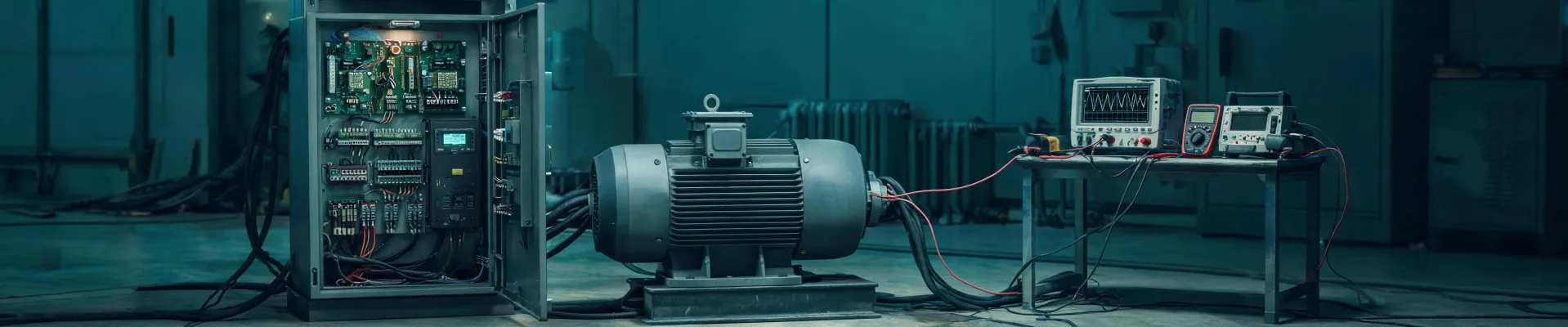
I've handled procurement and technical support for industrial automation orders for about 11 years. Most of my day is spent on Danfoss VFDs, but I also buy PLCs, safety PLCs, contactors, relays, timers, and enough control components to fill a small warehouse. I've made mistakes, and I've documented them so my team doesn't repeat them. The most expensive one started with a Danfoss VFD fault code that I read completely wrong.
The drive wasn't the problem
In March 2023, a rooftop exhaust fan was tripping the Danfoss VFD on AL 14, which is an earth-fault alarm. The drive would run for an hour or two, then shut down. The maintenance supervisor thought the drive was failing. I thought so too, and we didn't have time to argue.
According to Danfoss's VLT FC-series documentation (danfoss.com, accessed March 2026), AL 14 is a protective earth-fault trip. It tells you which protection threshold was crossed. It does not tell you which component failed. I ignored that distinction.
What the fault code was actually telling me
We ordered a replacement Danfoss VFD anyway. The new unit arrived, we installed it, and it ran for 37 minutes before showing the exact same AL 14 code. That is when the electrician stopped looking at the drive and started looking at the installation.
The motor cable had a small abrasion where it passed over a metal edge in the roof tray. It was probably caused by a repair weeks earlier. It wasn't visible from the floor. The insulation test showed low resistance between one phase and ground. The VFD's switching waveform caught the leakage current a standard motor starter might have ignored.
The drive said earth fault. I heard replace drive. I was wrong.
After we replaced the motor cable, the fault never came back. The original drive was later bench-tested and ran fine. The replacement VFD stayed in service, but it wasn't the fix. The total cost of the unnecessary purchase, freight, labor, and the second service visit was roughly $3,200. I might be off by a few hundred dollars, but the credibility cost was worse.
Why this mistake is so common in B2B buying
Fault codes look definitive. We see a message like earth fault, and we assume the drive knows why the fault happened. It doesn't. A VFD measures current, voltage, temperature, and frequency at its terminals. It can tell when a threshold is crossed, but it cannot tell you whether the cause is in the drive, the cable, the motor, or the mechanical load.
Everything I'd read about VFD fault codes suggested they lead you to the problem. In practice, they lead you to the category of the problem. That difference is expensive when you ignore it.
Pressure makes it worse. In a B2B environment, downtime creates panic. Buying a replacement drive looks like decisive action. Stopping to test the cable does not. I've felt that pressure, and I've paid for the mistake that came with it.
What transparency has to do with it
Since 2023, I've asked every new supplier the same question: what happens when a fault code appears? If the answer is vague, the quote isn't complete. I've learned to ask what is not included before I ask what the price is. A supplier who hides support, diagnostics, or return freight behind change orders is not saving you money. They're deferring the cost.
This applies to every control component I buy. When I evaluate a controller private label option, I ask for the manual, the error code list, and the escalation path before I ask for pricing. Some private-label controllers are excellent. But they are only worth buying when the company behind them can explain what a status code means.
Safety PLCs add another layer. I can't compress a full safety PLC distributor buying guide into this article, but the first rule is simple: ask for the safety manual and declaration of conformity before you place the order. If the distributor hesitates on documentation, keep looking.
A short checklist before you replace a Danfoss VFD
Here is the checklist I keep on my team's wall. It exists because of that AL 14 mistake.
- Record the exact fault code and the operating conditions right before the trip.
- Test the motor cable and motor before ordering a replacement drive if the fault is electrical.
- Ask the supplier what is not included in the quoted price.
- Ask how the supplier handles fault code questions and how fast they respond.
- Treat any repeated fault code as a system problem until proven otherwise.
Danfoss VFD fault codes are not your enemy. They are one of the few honest signals you get during a failure. They tell you a limit was crossed. Your job is to find out what crossed it. Replacing the drive should be the last move, not the first, because sometimes the drive is the only component doing exactly what it was designed to do.
I still buy Danfoss VFDs, and I still compare prices. But now I care less about the page-one price and more about who answers the technical question after the alarm appears. That is where the real cost of ownership shows up.

Rebecca Sloan
Rebecca Sloan is a power distribution and protection analyst specializing in circuit breakers, switchgear, contactors, fuses, surge protective devices, and coordination. She applies IEC 60947-2 breaker requirements, IEC 60269 fuse characteristics, and IEC 61643-11 tests while examining rated voltage, breaking capacity, time-current curves, selectivity, and prospective short-circuit current. She helps engineers and buyers compare protective devices against documented fault levels, installation conditions, maintenance access, and continuity priorities.