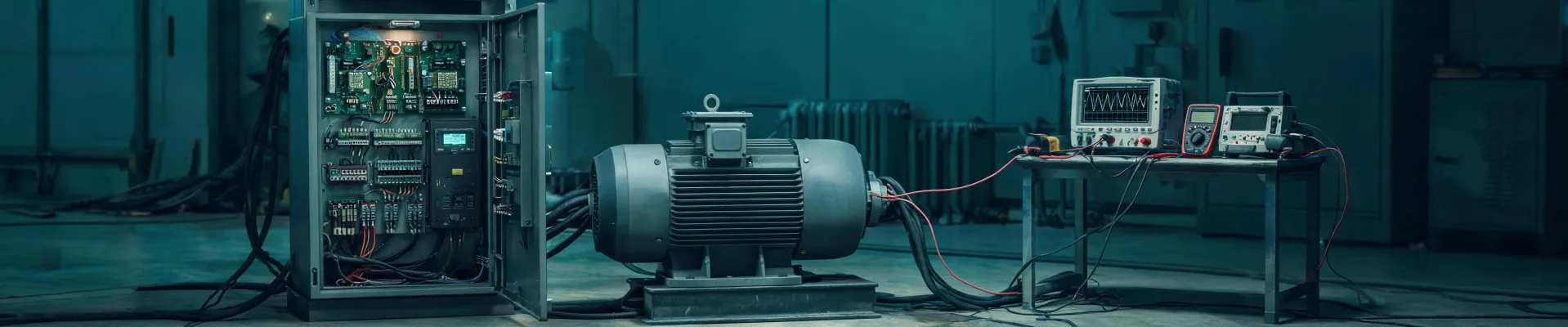
It was 4:47 on a Friday afternoon in March 2024 when my phone rang. On the other end was a maintenance engineer at a food-processing plant, and he skipped the hello. His conveyor line was down, his Danfoss VFD was flashing Alarm 14, and he had a production run locked in for Monday at 6 a.m.
In my role coordinating rush orders for industrial drives, that call isn't unusual. I've handled 300-plus emergency jobs over 11 years, including same-day turnarounds for OEM clients who couldn't wait on a standard lead time. You learn to triage in about ninety seconds: how much time is left, what's actually possible, and what's the worst case if we guess wrong. That Friday, all three answers made me nervous.
What Alarm 14 actually means (and doesn't)
Let's get the terminology straight first, because this is where most people jump off the wrong cliff.
On Danfoss VLT drives, Alarm 14 is an earth fault — a ground fault. The drive is detecting current leaking from the motor circuit to earth somewhere between the DC link and the motor. According to Danfoss's own VLT documentation, the alarm triggers on a ground fault on the output side or a leakage current that exceeds the drive's internal threshold. That's the whole definition. It does not tell you where the leak is. It doesn't even tell you if the leak is real.
What I mean by that is this: Alarm 14 is a symptom report from a sensor inside the drive, and that sensor is measuring a condition that could be caused by the drive, by the cable, by the motor, by moisture, or by a slowly-dying winding that only fails when the machine gets up to temperature. Four of those five causes live outside the drive. That ratio matters a lot when someone's about to spend $2,000 and lose a weekend waiting on freight.
The wrong assumption
His plan was straightforward: overnight a replacement drive, swap it Saturday, run Monday. Costs him a day of downtime plus the drive, but it's simple and it works. I get why he wanted that path. Under deadline pressure, a clean swap feels like control.
The numbers said ship the drive. My gut said not yet. I've watched too many people overnight a drive, install it, and watch Alarm 14 come back on the first start.
So I asked him three questions before I quoted anything.
- Disconnect the motor cable from the drive at U, V, and W. Power up the drive with nothing on the output. Does Alarm 14 clear?
- Megger the motor cable to earth.
- Open the motor junction box and look.
He pushed back. Fair enough — he's got a plant manager standing behind him and I'm asking him to troubleshoot instead of order. But he had one piece of information he hadn't mentioned yet.
The twist
He'd already swapped in a spare drive. Same model, pulled off the shelf, wired it up Thursday night. Alarm 14 came back within a minute of start.
That's the tell. That's the moment when you stop thinking about the drive.
Two identical drives, two identical alarms, same motor circuit. The only constant in that equation is the field wiring and the motor. Whatever's leaking to earth isn't inside the box — it's downstream of it.
He meg-ged the motor cable from Friday night into Saturday morning and found the fault. A chafed section of motor cable inside a washdown junction box, sitting in standing moisture. Not the drive. Not the motor. A forty-dollar cable and a gasket that had been letting water in for the better part of a year.
New cable, new gasket, resealed the box. Line ran Monday at 6 a.m. He never bought a drive from me that weekend.
What I'd tell you if you're staring at Alarm 14 right now
Here's the version of this I wish I could hand people at 4:47 on a Friday.
First, Alarm 14 is almost never the drive. I don't have hard data on the exact split between drive-caused and field-caused earth faults — I wish I'd tracked it more carefully over the years — but my sense from the emergency calls I've worked is that the overwhelming majority trace back to the motor cable, the motor winding, moisture, or a loose ground connection. A failing output stage inside the drive is real, but it's the rare case.
Second, disconnecting the motor cable is the fastest diagnostic you have. Pull U, V, and W off the drive terminals. Power it up with no load. If Alarm 14 clears, the drive is fine and your problem is downstream. If it still triggers with nothing connected, now you've got a drive problem — and now the replacement call makes sense.
Third, megger the cable and the motor separately. Insulation resistance to earth tells you which of the two is leaking. Take this with a grain of salt, since acceptable readings vary by drive size and motor rating, but if the cable reads low and the motor reads healthy, you've found it. If they both read healthy cold, run them hot. Some windings only fail when thermal expansion opens a weak spot.
Fourth, look with your eyes before you look with a meter. Open the junction box. Look for water, corrosion, chafe marks, chew marks, pinched insulation at the gland. More often than not, the answer is right there and somebody skipped it because the manual said "earth fault" and the manual pointed at the drive.
One thing people miss: the fault-signal side
While you're in there, check how the fault signal is wired back to your PLC or alarm panel. On most VLT drives, the fault output is a relay contact, and if that relay is banging thousands of cycles a year on a busy line, contacts pit and eventually fail open or closed. If you're speccing a replacement or building a new panel, that's the point where a relay specification guide earns its keep — you want the contact rating, the coil voltage, and the load type matched to what's actually on the other end. A fault relay that lies to your PLC is its own kind of alarm 14.
When replacing the drive IS the answer
I don't want this to read as "never ship a drive." That's not honest, and frankly it's not good business for anyone. There are situations where the drive is your problem, and I'll say so plainly:
- Alarm 14 with no motor connected and a fresh power cycle. If the drive faults with an empty output, the leakage is inside the box. Replace it.
- Physical damage. Burn marks, bulged DC-link caps, a smell you recognize the moment you open the cabinet door. Don't band-aid that.
- Age past service life. If the drive has been running 10+ years in a hot panel, you're on borrowed time regardless of what this alarm says.
- An OEM configuration you can't replicate. Some drives ship with custom parameter sets baked in at the factory. If your replacement needs to match the original drive manufacturer's OEM build — parameters, firmware, option cards, that specific thing — swapping the model number isn't enough. Match the whole configuration or you'll trade one fault for a week of commissioning.
If you're in one of those four buckets, call me. I'll ship it. If you're not, and you've got twelve hours before a production run, spend the first two on a megger and a flashlight. It costs almost nothing and saves you a drive.
What that Friday actually taught me
Nothing about drives. Everything about triage under pressure.
When a deadline is tight, the instinct is to reach for the biggest, most decisive move available — in this case, air-freight a new drive and swap it. But the biggest move isn't always the fastest one. The fastest move is the one that tells you what's actually wrong. Two hours of diagnosis beat a weekend of freight.
And honestly? Losing that drive sale was the best outcome for both of us. He fixed his line for the cost of a cable. He called me three weeks later when he needed two more drives for a different line, and he didn't shop around. That's the part of this job I actually like — the call that comes after the emergency, when somebody trusts you because you didn't sell them something they didn't need.
Alarm 14 shows up on your panel? Unhook the motor. Grab the megger. Look in the box. Then call me. Chances are you won't need me to ship anything — but if you do, I'll know it's the right thing to send.

Kwame Boateng
Kwame Boateng is a transformer and power-conversion analyst specializing in distribution transformers, power supplies, inverters, and network integration. He uses IEC 60076 test data for transformer ratio, impedance, losses, and temperature rise, and IEC 62477-1 safety requirements for converter insulation and thermal boundaries while separately comparing harmonics and efficiency curves. He helps engineers and sourcing teams compare equipment against duty profiles, environmental limits, short-circuit behavior, lifecycle energy cost, and service requirements.